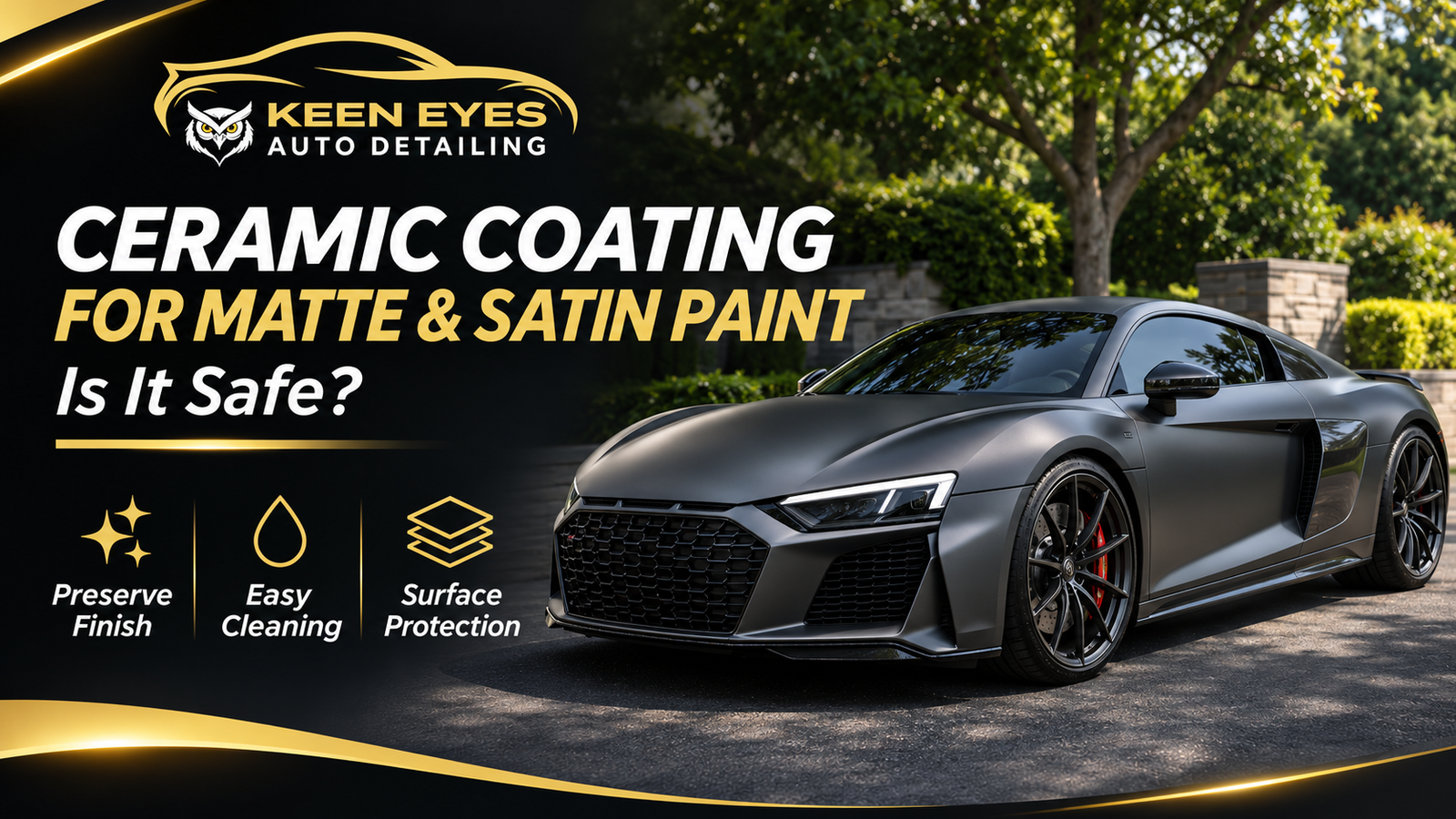
Matte and satin paint finishes give vehicles a distinctive appearance that stands apart from traditional glossy paint. However, their unique texture also means they require specialized cleaning and protection.
If you own a matte or satin vehicle, you may wonder whether ceramic coating is safe or whether it could make your finish look shiny.
The answer is yes—ceramic coating can be safe for matte and satin paint when the product is specifically designed for these finishes and applied correctly.
Unlike traditional glossy paint, matte and satin surfaces require protective products that preserve their original appearance.
In this guide, we’ll explain how ceramic coating works on matte and satin paint, its benefits, potential risks, and how to maintain your vehicle after application.
What Makes Matte and Satin Paint Different?
Before choosing a protective treatment, it’s helpful to understand how these finishes differ from conventional glossy automotive paint.
Matte Paint Finish
Matte paint has a low-reflection appearance that creates a smooth, non-glossy look.
Instead of producing sharp reflections, its surface scatters light to create a muted finish.
Because the appearance depends on the surface texture, polishing or aggressive rubbing can create unwanted shiny areas.
Satin Paint Finish
Satin paint falls between matte and gloss.
It has a subtle sheen but doesn’t produce the highly reflective appearance associated with traditional glossy paint.
Like matte paint, satin finishes require appropriate cleaning products and careful maintenance to preserve their intended appearance.
Matte vs. Satin vs. Gloss Paint
| Feature | Matte Paint | Satin Paint | Gloss Paint |
|---|---|---|---|
| Appearance | Flat, muted finish | Soft, subtle sheen | Highly reflective |
| Light reflection | Low | Moderate | High |
| Traditional polishing | Generally unsuitable | Generally unsuitable | Often suitable |
| Cleaning requirements | Finish-specific care | Finish-specific care | Conventional paint-safe care |
| Ceramic coating | Matte-compatible formula | Satin-compatible formula | Suitable conventional coating |
The most important difference is that matte and satin finishes cannot typically be polished to remove imperfections without changing their appearance.
Can You Apply Ceramic Coating to Matte and Satin Paint?
Yes. Certain ceramic coatings are formulated specifically for matte and satin automotive finishes.
These products create a protective layer while helping preserve the surface’s original low-gloss appearance.
However, not every ceramic coating is appropriate.
Some conventional coatings are designed to increase gloss and may alter the appearance of matte or satin paint.
Does Ceramic Coating Make Matte Paint Shiny?
A properly selected matte-compatible ceramic coating should preserve the finish’s intended appearance.
However, different products may create subtle changes in color depth or surface sheen.
For this reason, it’s important to:
- Choose a coating approved for matte or satin surfaces.
- Review the manufacturer’s application instructions.
- Evaluate the paint’s condition before installation.
- Test compatibility in a discreet area when appropriate.
- Use professional application techniques.
The goal is to protect the finish without creating uneven reflections or unwanted gloss.
Benefits of Ceramic Coating for Matte and Satin Paint
Matte and satin finishes can be more challenging to maintain because conventional polishing is generally not an option.
A suitable ceramic coating can help simplify maintenance while preserving the original appearance.
1. Helps Protect Against Environmental Contaminants
Everyday driving exposes your vehicle to road grime, dust, insect residue, and other contaminants.
Ceramic coating provides an additional surface layer that can help reduce how strongly certain contaminants adhere.
However, bird droppings, bug residue, and other potentially damaging substances should still be removed promptly.
2. Makes Routine Cleaning Easier
Quality ceramic coatings offer hydrophobic properties that help water bead and move across treated surfaces.
This can make dirt and residue easier to remove during routine washing.
For matte and satin paint, easier cleaning is especially valuable because aggressive scrubbing can damage the appearance.
3. Helps Preserve the Original Finish
Matte-specific coatings are designed to maintain the finish’s low-gloss characteristics rather than create a mirror-like shine.
This allows vehicle owners to add protection while retaining the visual appearance they prefer.
4. Provides Additional UV Resistance
Some ceramic coatings can help reduce certain effects of environmental exposure.
However, UV performance varies by product, and ceramic coating cannot completely prevent fading or paint deterioration.
5. Supports Long-Term Maintenance
By making routine washing easier, ceramic coating may help reduce the need for aggressive cleaning.
The coating still requires proper maintenance, and its lifespan depends on the product, preparation, driving conditions, and washing habits.
Matte and Satin Ceramic Coating: What Can It Protect Against?
Understanding the limitations of ceramic coating is just as important as understanding its benefits.
| Environmental Concern | How Ceramic Coating May Help |
|---|---|
| Dust and road grime | Makes routine removal easier |
| Water and moisture | Creates water-repelling properties |
| Bug residue | May reduce adhesion to treated surfaces |
| Bird droppings | Provides some resistance, but prompt removal remains necessary |
| UV exposure | May provide additional resistance depending on the coating |
| Light washing marks | May offer limited resistance but cannot prevent scratches |
| Rock chips | Does not provide reliable impact protection |
| Deep scratches | Cannot prevent or repair them |
Ceramic coating is a surface-protection treatment, not a substitute for paint protection film or physical paint repair.
Can Ceramic Coating Damage Matte or Satin Paint?
Ceramic coating itself isn’t automatically harmful to matte or satin paint.
Problems are more likely when the wrong product is selected, the surface is prepared incorrectly, or the coating isn’t applied properly.
Using a Gloss-Enhancing Product
Some coatings are formulated to increase shine.
Using an incompatible product may change the appearance of a matte or satin finish.
Incorrect Surface Preparation
Matte and satin paint require careful cleaning before coating installation.
Conventional machine polishing should generally be avoided because it can permanently alter the surface’s light-reflecting texture.
Uneven Coating Application
Improper application may leave streaks, high spots, or uneven-looking areas.
Correcting these issues can be more complicated on matte paint because conventional polishing is often unsuitable.
Aggressive Cleaning Products
Harsh chemicals, abrasive compounds, and inappropriate cleaning methods can affect the coating or underlying finish.
Professional product selection and careful application help reduce these risks.
How Is Ceramic Coating Applied to Matte and Satin Paint?
The process differs from coating traditional glossy paint, particularly during surface preparation.
Step 1: Inspect the Finish
The detailer evaluates the condition of the paint and identifies contamination, stains, damage, or existing protective products.
They should also establish whether the surface is factory matte paint, satin paint, or a matte paint protection film.
Step 2: Clean the Vehicle
The vehicle is washed using suitable, non-abrasive cleaning products.
This removes loose dirt and prepares the surface for further inspection.
Step 3: Remove Contamination Carefully
Any additional cleaning or decontamination should follow methods approved for the specific finish.
Abrasive clay treatments and polishing can potentially alter matte surfaces, so they should not be treated as routine preparation steps.
Step 4: Apply a Compatible Ceramic Coating
The selected matte- or satin-compatible coating is applied according to the manufacturer’s instructions.
The detailer checks for even coverage and addresses residue before it becomes difficult to remove.
Step 5: Allow the Coating to Cure
The coating requires an appropriate curing period.
Your installer should provide instructions for washing, moisture exposure, and ongoing maintenance based on the product used.
Ceramic Coating vs. Paint Protection Film for Matte Paint
Both ceramic coating and paint protection film can be useful, but they address different concerns.
| Feature | Matte-Compatible Ceramic Coating | Matte/Satin Paint Protection Film |
|---|---|---|
| Main purpose | Surface protection and easier cleaning | Physical protection against impacts and abrasions |
| Appearance | Helps preserve existing finish | Can preserve or create a matte/satin appearance |
| Hydrophobic properties | Typically strong | Depends on film and surface treatment |
| Rock chip resistance | Limited | Greater physical protection |
| Scratch resistance | Limited | Helps resist certain abrasions |
| Maintenance | Requires gentle washing | Requires film-appropriate care |
If your primary concern is reducing the risk of rock chips, a suitable paint protection film may offer advantages.
If your main goal is easier cleaning and maintaining the appearance of an existing matte finish, ceramic coating may be appropriate.
Some compatible paint protection films can also receive ceramic coating, provided the film and coating manufacturers approve the combination.
How to Maintain Matte or Satin Paint After Ceramic Coating
Proper maintenance is essential for keeping your finish looking consistent.
Use Appropriate Car Wash Products
Choose gentle, non-abrasive cleaning products approved for matte or satin surfaces.
Avoid products intended to add gloss unless specifically approved for your finish.
Wash Regularly
Remove dust, road grime, and other contaminants before they accumulate.
Use clean washing tools and gentle techniques to reduce unnecessary friction.
Avoid Wax and Conventional Polish
Traditional polishing compounds and gloss-enhancing waxes can change the appearance of matte paint.
Follow the coating manufacturer’s maintenance recommendations instead.
Remove Contaminants Promptly
Bird droppings, insect residue, and tree sap can damage a finish if allowed to remain for extended periods.
Use suitable products and avoid aggressive rubbing.
Follow Your Installer’s Instructions
Curing times, maintenance products, and recommended washing methods vary.
Always follow the instructions for the specific coating installed on your vehicle.
Protect Your Matte or Satin Finish With Keen Eyes Auto Detailing
Matte and satin paint finishes deserve specialized care. Choosing the wrong cleaning product or protective treatment can affect their appearance, while a properly selected ceramic coating can help maintain their distinctive finish and make everyday cleaning easier.
At Keen Eyes Auto Detailing, we provide professional ceramic coating and vehicle protection services in Stafford, VA, serving drivers from nearby communities, including Quantico. Our team can evaluate your vehicle’s finish, discuss compatible protection options, and recommend an appropriate approach to maintaining its appearance.
Ready to give your matte or satin vehicle the attention it deserves? Contact Keen Eyes Auto Detailing or visit us at 227 Garrisonville Rd, Stafford, VA 22554, to discuss your ceramic coating options.